At a Glance
For many modern businesses, sustainability has become central to the corporate mission. However, a common challenge remains: how do you move from general policy to embedding sustainability into the daily actions of your workforce? The answer often lies in how you structure employee engagement. Research indicates that volunteering is not just an expression of company culture, but a powerful mechanism for embedding sustainability deeply within it. By strategically integrating CSR into management practices, companies can turn volunteering into a "behavioural gateway." When employees engage in physical acts of sustainability, like planting trees or reducing waste at a charity event, they are statistically more likely to adopt eco-friendly behaviours in their daily office roles. Here is how you can transform your volunteering programme into a powerful engine for your company’s sustainability ethos.
Why Volunteering Matters for Sustainability Culture
Volunteering creates a powerful feedback loop known as the "Ripple Effect." When leadership participates in sustainability initiatives, it provides social proof that these values are authentic, rather than just a PR tactic. This actively "licenses" employees to prioritise long-term thinking over short-term efficiency in their regular work. It fosters a genuine culture where ESG responsibilities are shared by everyone, rather than being limited to a single department. Ultimately, visible volunteering answers the difficult question of how to embed sustainability within your workforce, bridging the gap between high-level strategy and on-the-ground behaviour.
-
Integrate Sustainability Themes Into Volunteering Opportunities
You do not need to reinvent the wheel to create impactful sustainability volunteer opportunities. You can simply apply a 'Green Overlay' to your existing activities, a practical strategy for embedding sustainability themes into standard volunteering without changing the core activity.
For example, you might conduct eco-education workshops. Instead of just painting a school fence, you could include a 30-minute module on why you are using low-VOC paint or planting native species.
Another approach is to mandate that all volunteering events, even soup kitchen runs, are zero-waste events. This trains employees in logistics and supply chain management principles that they can bring back to the office.
Finally, you can turn a standard park cleanup into citizen science by having volunteers use apps to catalogue species while they clean, contributing vital data to local conservation groups.
-
Use Skills‑Based Volunteering for Environmental Causes
One of the most effective ways to support environmental non-profits is by structuring sustainability volunteer opportunities around Skills-Based Volunteering (SBV). This approach transfers high-value corporate assets to under-resourced NGOs and highlights the diverse ESG roles in companies today.
There are numerous ways to apply professional skills: legal teams can help conservation NGOs navigate complex land-rights or conservation easement laws, while IT teams assist non-profits by building Machine Learning models to automate the identification of species in camera trap images or analyse satellite data to track deforestation rates.
Other ideas could include marketing departments that help wildlife trusts rebrand to attract younger demographics, or supply chain experts that help food rescue non-profits optimise delivery routes to lower fuel consumption.
-
Align Volunteering with Your Company’s SDGs
Research by the World Business Council for Sustainable Development (WBCSD) reveals that, while 79% of member companies acknowledge the SDGs in their reports, only 6% have aligned their strategy with specific, measurable targets. This is called "SDG Washing", claiming support for the Global Goals without verifiable action.
To avoid being complicit, which can damage your credibility and company culture, treat your volunteering program as a precision tool. Instead of broadly claiming to support "Climate Action" (SDG 13), map your volunteering initiatives to the specific UN Targets designed to mitigate environmental damage. This transforms your cross-functional CSR from abstract philanthropy into a reportable contribution toward the 2030 Agenda.
Here are some specific Targets you can assign to common environmental volunteering activities.
-
For Waste Reduction & Cleanup Initiatives:
-
Target 12.5: By 2030, substantially reduce waste generation through prevention, reduction, recycling and reuse.
-
Activity: Office e-waste collection drives or repair cafes.
-
For Marine Debris & Waterway Restoration:
-
Target 14.1: By 2025, prevent and significantly reduce marine pollution of all kinds, in particular from land-based activities, including marine debris.
-
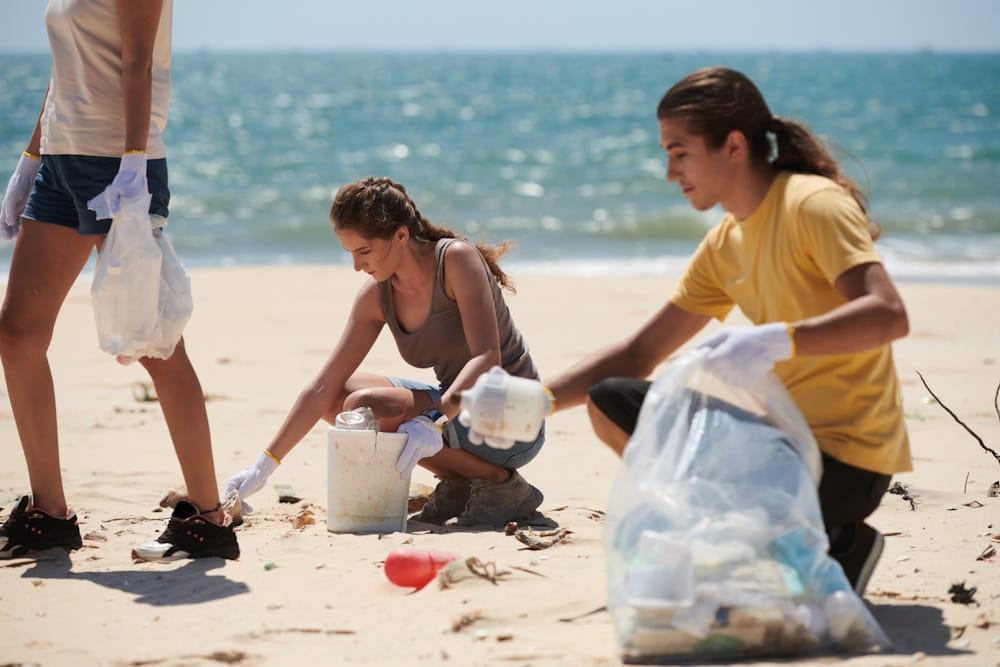
Activity: Beach cleanups or riverside litter picking.
-
For Education & Advocacy:
-
Goal: SDG 13 (Climate Action)
-
Target 13.3: Improve education, awareness-raising and human and institutional capacity on climate change mitigation, adaptation, impact reduction and early warning.
-
Activity: Employees delivering "Climate Fresk" workshops to local schools or community groups
-
-
Capture and Share Impact to Reinforce Behaviour Change
To reinforce a genuine sustainability ethos, you must measure the result of the work, not just the effort. Leverage the Input-Output-Impact framework to tell a credible, data-backed story to your team that will help form an emotional connection. Leverage "Impact Conversion", or in other words, what the company's volunteering day actually contributed to the planet.
You can achieve this by reporting the tangible Output of the volunteering event, such as "We removed 2 tons of invasive species" or "We restored 5 acres of riparian habitat". Subsequently, you can predict the long-term social and environmental impact of these outputs, such as the revitalisation of native biodiversity indices or improved flood resilience and water quality for the local community.
Moreover, if you are struggling with how to embed sustainability within your workforce, measuring behavioural shifts following volunteering events provides the proof of concept you need. Adopt a "Pre/Post" methodology by surveying employees before and after an event to track the adoption of pro-environmental behaviours (PEBs). Are they now commuting differently? Have they reduced single-use plastics in the office?
Finally, close the loop by sharing these metrics in internal communications, such as newsletters. Feature "Eco-Champions" who have successfully applied environmental knowledge gained from volunteering to their daily roles. This validates the activity not just as charity, but as a core driver of your company's Net Zero strategy.
-
Link Volunteering with Your Sustainability KPIs
Investors are increasingly interested in how human capital strategies affect the environment. To meet these evolving requirements and truly reinforce your sustainability ethos, you must connect your volunteering data and your corporate sustainability KPIs. Instead of treating these as separate streams, align your volunteer metrics directly with the environmental frameworks you likely already use, such as the GRI 300 Series (Environmental) and SDG 13 (Climate Action).
Rather than simply tracking participation, companies should measure outcomes. For instance, with Scope 3 emissions often accounting for over 70% of a corporate carbon footprint (Deloitte), volunteering is a proven lever for mitigation. Research indicates that employees who engage in environmental volunteering are significantly more likely to adopt pro-environmental behaviours (PEBs) in their daily lives, directly impacting waste and energy metrics.
Leading organisations have taken notice, with recent data revealing that 39% of businesses now cite "Environment and Conservation" as their primary volunteering focus, surpassing all other categories. This can include tracking the kilograms of waste diverted from landfills (GRI 306), area of habitat restored (GRI 304), or the % reduction in employee commuting emissions following green-transport education.
Seamlessly Manage with Kindlink’s Volunteering Tools
Managing these metrics and alignments manually can be difficult, but Kindlink acts as a complete CSR ecosystem designed to streamline this process.
Kindlink’s Corporate Volunteering Platform provides a unified space for employees and HR professionals to find, create, and track volunteering opportunities that align with your team´s values and your company´s sustainability goals. It features a native SDG Dashboard that visualises how your sustainability volunteer opportunities map against specific SDGs, automating the alignment process mentioned earlier.
The platform also facilitates transparency by allowing non-profits to upload "impact updates" directly to your corporate dashboard, closing the feedback loop for employees and proving the value of their time.
Book a demo today and see how your volunteering programme can become the heartbeat of your corporate culture, becoming your tool for embedding sustainability across every department.