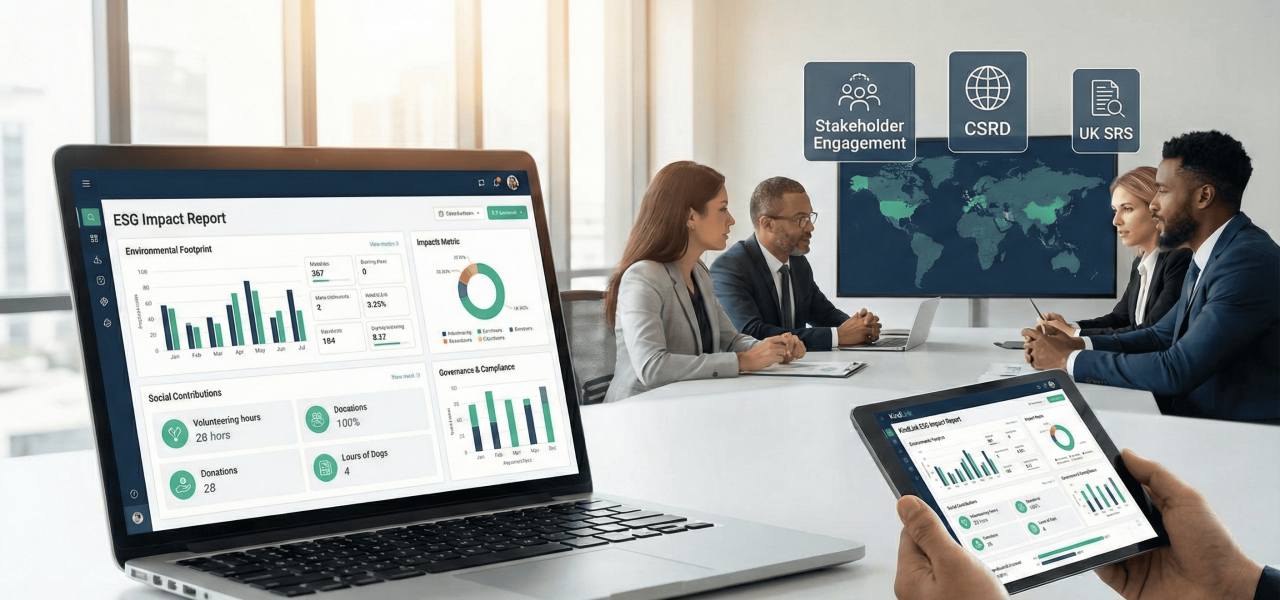
At a Glance
Reporting on social and environmental impact used to be a voluntary exercise, but in the past decade, it has become a business requirement. Companies spend a plethora of time and resources on organising volunteering days, matching donations, and reducing carbon footprints. But proving the value of this hard work to stakeholders can feel like an entirely separate battle.
Failing to capture the right data accurately risks non-compliance with new regulations and alienates a workforce that craves purpose. However, establishing a robust reporting rhythm turns these obligations into opportunities for growth and engagement.
Why Impact Reporting Matters Now More than Ever
The imperative for high-quality impact reporting has never been more acute. In 2025, internal corporate operations are becoming ever more visible to an increasingly sceptical and empowered array of external stakeholders. This has created a two-fold pressure on companies to report on their impact with transparency and rigour.
On the one hand, regulatory frameworks like the EU’s Corporate Sustainability Reporting Directive (CSRD) and the UK’s emerging Sustainability Reporting Standards (UK SRS) are setting impact reporting standards. If in the past, creating a sustainability impact report was largely voluntary and used as a marketing tool, now it is becoming mandated by legislation. What is more, investors increasingly demand transparent ESG impact reporting to assess risk and future enterprise value.
On the other hand, your employees want to know their work makes a difference. They need to see that their employer truly cares. Providing a clear sustainability impact report verifies their contributions and deepens their connection to your company. In a competitive talent market, being able to prove your purpose is a powerful retention tool.
How to maximise the benefits of your ESG impact reporting:
1. Align Your Metrics with Stakeholder Needs
Navigating the alphabet soup of impact reporting standards can be daunting. To make your reporting beneficial, you must select frameworks that align with your specific geography and key stakeholders. For UK businesses, this means looking at the ISSB-aligned UK SRS for investors, while keeping an eye on broader GRI standards for community stakeholders.
Focusing on the right data ensures your sustainability impact report resonates:
-
Track Climate Data: Scope 1, 2, and 3 emissions are now non-negotiable under SECR.
-
Measure Social Mobility: Reporting on socio-economic backgrounds supports the UK's "Levelling Up" agenda.
-
Quantify Community Investment: Use the LBG/B4SI framework to value cash, time, and in-kind donations accurately.
2. Build Credibility Through Transparency
Creating a report that resonates requires honesty. It is crucial for your business to ensure due diligence on reporting to avoid potential greenwashing. Discrepancies between marketing claims and data reality can damage trust. A strong sustainability impact report acknowledges missed targets and outlines remediation plans.
A common pitfall in sustainability reporting is failing to establish a consistent feedback loop. Publishing a PDF once a year is insufficient to demonstrate to stakeholders your social and environmental impact. You must engage them by sharing the specific outcomes of their contributions regularly, transforming ESG impact reporting from a broadcast into a conversation.
3. Automate Data Collection to Report Smarter
Attempting to measure CSR impact using multiple uncoordinated data sources that rely on spreadsheets invites human error and version control nightmares. Centralising your data is the only way to ensure accuracy and readiness for assurance audits.
Selecting the right software is a strategic decision that allows you to move faster:
-
Ensure Compliance Readiness: Your tool must map data to impact reporting standards like CSRD and UK SRS.
-
Demand Integration: The platform should talk to your HR and Finance systems to automate participation tracking.
-
Prioritise User Experience: If the tool is hard to use, employees will not participate actively in your CSR programme (e.g. log their volunteering hours, request donation matching or create their own campaigns).
Unlike disjointed systems that isolate data, KindLink integrates these functions to help you measure CSR impact seamlessly.
4. Transform Reporting into Employee Engagement
Your employees want to know that their workplace makes a positive difference in the world. They need to see that their employer is actively representing their values. Providing a clear sustainability impact report verifies their contributions and deepens their connection to your company.
In a competitive talent market, being able to measure CSR impact and prove your purpose is a powerful retention tool. When employees see their specific volunteering hours or donations reflected in the company’s aggregate impact, they feel a greater sense of belonging and pride.
How KindLink Makes Reporting Part of Your Long-Term Strategy
KindLink transforms reporting from a compliance chore into a culture-building engine. By unifying your data, you can produce a comprehensive ESG impact reporting document that satisfies auditors and inspires employees.
Empower Your Employees
-
Attract and retain talent: Give your team a dedicated place to do good, boosting retention by validating their purpose.
-
Build skills: Facilitate skills-based volunteering that benefits charities while developing your team's professional abilities.
-
Showcase transparency: Display real-time impact on the "KindWall" to show recruits a dynamic and authentic community profile.
Visualise Your Impact
-
Receive real-time updates: Track every pound raised and hour volunteered as it happens.
-
Automate data collection: Save countless hours by automatically aggregating Input, Output, and Impact data.
-
Build robust reports: Generate a sustainability impact report that is compliant with the reporting framework that fits your needs.
Engage Your Customers
-
Promote authentic stories: Share genuine updates and photos from the charities you support directly to your social media.
-
Demonstrate brand values: Let customers see the tangible difference your business makes in the community.
Moving beyond simple compliance allows you to measure CSR impact in a way that drives genuine business value. ESG impact reporting should not be a burden; it should be the lens through which you view your company's contribution to the world.
Book a demo to see how KindLink can streamline your reporting today.